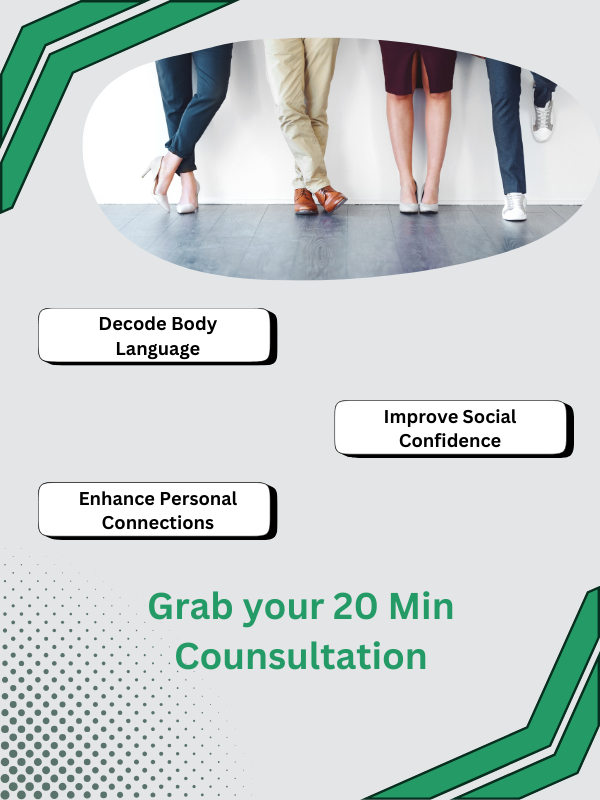
What may be happening
Difficulty reading or expressing yourself confidently in social situations often shows up through thoughts, emotions, habits, or relationship patterns before it feels easy to explain clearly.
Mental Health Support
Improve communication with body language counselling at Click2Pro. Decode nonverbal cues. Get 20 mins free consultation now.
Get 20 Minutes Free Session
Continue with Click2Pro on WhatsApp for a calm, issue-focused next step.
Understanding The Concern
Difficulty reading or expressing yourself confidently in social situations can start affecting more than one part of life at once. The signs are not always dramatic, but they can change how you think, cope, relate to other people, or get through the day.
If parts of this already feel familiar, the sections below can help you recognise how the pattern may be showing up in daily life and where support may help.
What often comes with this kind of strain
Difficulty reading or expressing yourself confidently in social situations often shows up through thoughts, emotions, habits, or relationship patterns before it feels easy to explain clearly.
Many people keep adapting around difficulty reading or expressing yourself confidently in social situations, which can make the strain feel normal even when it is already affecting daily balance.
The effect of difficulty reading or expressing yourself confidently in social situations can reach mood, routine, confidence, communication, or the ability to feel settled through the day.
Counselling can make difficulty reading or expressing yourself confidently in social situations feel more understandable, less isolating, and easier to respond to with steadier next steps.
Daily-Life Understanding
These signs can make it easier to recognise how the issue may be affecting thoughts, feelings, behaviour, or relationships in everyday life.
difficulty reading or expressing yourself confidently in social situations may build gradually, so people often notice the consequences before they feel confident naming what is happening.
Even when difficulty reading or expressing yourself confidently in social situations is not obvious from the outside, it can influence patience, decision-making, focus, confidence, or emotional steadiness.
Rather than addressing difficulty reading or expressing yourself confidently in social situations directly, many people start compensating through avoidance, overthinking, silence, or self-pressure.
Once difficulty reading or expressing yourself confidently in social situations affects more than one area of life, it often starts feeling heavier, more confusing, and harder to carry alone.
Common Patterns
These are some of the cycles, habits, and internal responses that can make the issue feel heavier over time.
Where the pattern often shows up
People dealing with difficulty reading or expressing yourself confidently in social situations often find themselves replaying thoughts, conversations, fears, or unfinished decisions more than they want to.
Short-term coping around difficulty reading or expressing yourself confidently in social situations can look useful at first, but over time those habits may keep the strain active.
When difficulty reading or expressing yourself confidently in social situations stays unresolved, routines and reactions may begin to revolve around managing discomfort rather than feeling genuinely steady.
It is common for difficulty reading or expressing yourself confidently in social situations to ease briefly and then return when the deeper pattern underneath has not been addressed.
Impact Areas
Strain like this rarely stays in one place. It often reaches emotions, routines, confidence, relationships, or the way the body settles after stress.
Impact 01
difficulty reading or expressing yourself confidently in social situations can affect mood, irritability, self-trust, or the ability to recover emotionally after everyday situations.
Impact 02
The concern may influence avoidance, overcompensation, withdrawal, reassurance-seeking, or the way someone approaches ordinary tasks.
Impact 03
difficulty reading or expressing yourself confidently in social situations can change communication, closeness, patience, or the sense of safety people feel around others.
Impact 04
Sleep, energy, concentration, productivity, and daily structure often begin to shift when difficulty reading or expressing yourself confidently in social situations is taking up more space than it seems.
When Support Is Usually Needed
These are common points where people decide that coping alone is no longer enough and a steadier kind of support may help.
Who This Support Is For
If your experience sounds similar to the points below, it may be a sign that this kind of support could be relevant for you.
Self-Check Indicators
These markers are meant to support clarity, not self-diagnosis. They can help you notice whether the issue is influencing everyday functioning in a meaningful way.
Indicator 01
You notice that difficulty reading or expressing yourself confidently in social situations is returning often enough to affect how you think, feel, or respond through the day.
Indicator 02
Decisions are increasingly being made around the discomfort or pressure linked with difficulty reading or expressing yourself confidently in social situations, not only around what you actually want.
Indicator 03
Small triggers or ordinary situations connected with difficulty reading or expressing yourself confidently in social situations are taking more time to settle than they used to.
Indicator 04
You may understand parts of difficulty reading or expressing yourself confidently in social situations intellectually, while still feeling stuck when trying to reduce its effect on your own.
How Counselling Can Help
Support can help you make sense of what is happening, respond more steadily, and work on the patterns that are keeping the issue active.
Support helps clarify what is really feeding difficulty reading or expressing yourself confidently in social situations rather than only reacting to the latest episode or trigger.
Counselling can link difficulty reading or expressing yourself confidently in social situations with the parts of life it is affecting most, including relationships, confidence, routine, or emotional steadiness.
Therapy can support steadier coping, better regulation, and clearer next steps around difficulty reading or expressing yourself confidently in social situations.
The goal is not only relief, but a clearer way of understanding, managing, and responding to difficulty reading or expressing yourself confidently in social situations over time.
What Sessions May Focus On
These are the kinds of practical areas people often work on once support begins.
Sessions often begin by clarifying how difficulty reading or expressing yourself confidently in social situations is currently showing up rather than assuming one fixed story about it.
Support may focus on triggers, beliefs, stress responses, and behaviour patterns connected with difficulty reading or expressing yourself confidently in social situations.
Therapy can then shift toward emotional regulation, clearer coping, better boundaries, and a steadier way of handling difficulty reading or expressing yourself confidently in social situations.
Sessions can track what is changing, what is still difficult, and which kinds of support are most useful going forward.
Online Counselling
Online support can make it easier to begin privately, keep momentum, and stay consistent without adding more strain to daily life.
Step 01
You do not need to explain everything perfectly at once. Begin from the part that currently feels heaviest or most disruptive.
Step 02
Online support can help connect the concern with the habits, emotions, and situations that keep it active.
Step 03
Click2Pro keeps the path simple through online sessions, psychologist profile review, and WhatsApp-based guidance when you want it.
What the next step can look like
Myths vs Reality
These clarifications can help if doubt, self-minimising, or mixed advice has made it harder to decide whether support is worth considering.
Myth
It only matters if it becomes extreme.
Reality
Even when difficulty reading or expressing yourself confidently in social situations seems manageable on the surface, persistent strain can still affect functioning, confidence, and emotional balance.
Myth
If you understand it, it should be easy to fix alone.
Reality
Insight is important, but change often becomes easier when the deeper pattern is worked through in a more structured way.
Myth
Support is only useful when the situation becomes unmanageable.
Reality
Many people benefit before the issue reaches crisis level, especially when they want clarity, steadier coping, and a healthier next step.
Psychologists at Click2Pro
If you want to see who you may be speaking with, you can review a few psychologist profiles here before taking the next step.

Expertise

Expertise

Expertise
Speak With Click2Pro
If this is starting to affect day-to-day life, you can explore Body Language Counselling through Click2Pro on WhatsApp, review psychologist profiles, or use Contact Us if you would like a calmer next step.
Full Detailed Guide
If you want the earlier long-form information on Body Language Counselling, you can continue with the preserved guide below.
Body language counselling has become an essential tool for understanding and improving nonverbal communication, especially in today's fast-paced, digital world. At Click2Pro, we recognize that effective communication goes beyond words; body language plays a crucial role in conveying emotions, intentions, and thoughts that may not be easily verbalized. Through body language counselling, individuals can uncover deeper insights into their own feelings and behaviors, enhancing their personal and professional relationships.
Our body language counselling service empowers individuals facing challenges like anxiety, stress, or social discomfort to decode and improve their nonverbal cues. We utilize proven techniques to help clients become more mindful of their gestures, posture, and facial expressions. These skills foster self-awareness and interpersonal effectiveness, which are especially valuable in managing life’s stressors.
For those interested in blending body language counselling with online counselling services, Click2Pro offers remote sessions tailored to your unique needs, ensuring a supportive environment even from a distance.
With our empathetic, professional guidance, clients feel understood and supported, leading to lasting improvements in their communication and mental well-being.
Understanding and interpreting body language can be challenging, especially when emotions run high. Many individuals seeking body language counselling face difficulties in recognizing how their nonverbal cues might inadvertently signal anxiety, distrust, or even discomfort to others. These hidden signals can affect relationships and workplace interactions, often without conscious awareness. Our specialized body language counselling at Click2Pro helps uncover these patterns, offering strategies to modify them for positive outcomes.
Common challenges that can be addressed through body language counselling include social anxiety, emotional suppression, and difficulty establishing trust. For instance, someone struggling with social anxiety might unknowingly display closed-off body language, which could hinder connection-building efforts. Through our best online therapy India approach, clients can learn body language techniques to appear more approachable and confident in social situations, creating meaningful connections that enrich their lives.
In addition to seeking body language counselling, there are simple strategies you can apply independently to enhance your nonverbal communication. Practicing these techniques can build confidence, reduce stress, and make interactions more fulfilling. One effective technique is to focus on maintaining an open posture, such as uncrossed arms and a relaxed stance, which projects openness and reduces perceived tension. Similarly, making eye contact during conversations can demonstrate attentiveness and foster stronger connections.
For individuals experiencing body language counselling sessions at Click2Pro, self-help tips like these complement professional guidance, providing a balanced approach to mastering body language skills. Remember, small changes in posture and gestures can make a significant difference in how others perceive you, empowering you to navigate social situations with ease.
While there are several ways to improve body language independently, the insights gained through professional body language counselling go far beyond self-help. Professionals at Click2Pro analyze subtle gestures, expressions, and postures, helping clients understand the underlying emotional cues they may unknowingly display. This awareness is especially valuable for those facing complex issues such as anxiety, low self-esteem, or relational challenges.
With body language counselling, clients benefit from expert guidance tailored to individual needs, fostering a deeper understanding of nonverbal signals. Professional counselling provides structured support and feedback that self-help alone may lack, ultimately leading to enhanced self-awareness and effective communication skills.
At Click2Pro, our body language counselling approach is tailored to meet each client's unique needs, combining evidence-based techniques like cognitive behavioral therapy (CBT) and mindfulness. Our counselors help clients decode nonverbal cues and practice positive body language habits. This holistic approach to body language counselling enhances self-awareness and provides practical tools for effective communication.
In addition to one-on-one sessions, Click2Pro offers virtual sessions for flexibility. Our structured, individualized methods ensure clients experience personal growth in areas such as self-confidence and relationship building.
Clients often share positive outcomes after engaging in body language counselling with Click2Pro. For example, one client experienced a breakthrough in overcoming social anxiety by learning to adopt open and welcoming body language. Another found confidence in public speaking, using tailored nonverbal strategies to project calm and authority.
These success stories highlight how body language counselling can bring transformative results, enhancing both personal and professional interactions, ultimately leading to more fulfilling relationships.
India: Over 60% of young adults report struggling with social anxiety and nonverbal communication in professional settings.
Worldwide: Approximately 1 in 3 adults feels their nonverbal cues lead to misunderstandings in relationships.
1: What is body language counselling?
A: Body language counselling focuses on understanding nonverbal cues, like gestures and posture, to enhance communication and self-awareness. Through body language counselling, clients gain insights into hidden aspects of their behavior that affect their relationships and personal growth.
2: How does body language counselling help with social anxiety?
A: Body language counselling teaches clients to adopt open, confident nonverbal cues, helping reduce social anxiety and improve interpersonal interactions.
3: Can body language counselling improve workplace relationships?
A: Yes, body language counselling enables individuals to project confidence and connect effectively, leading to better professional relationships and workplace success.
Take the first step toward mastering body language. Click2Pro offers a 20-minute free session to help you explore how our counselling can transform your communication skills. Book your free consultation now!
Click2Pro Homepage
If Body Language Counselling is only part of what you are trying to understand, the homepage gives a broader overview of support options across India.
Related discovery
These options stay close to what you may be dealing with, so it is easier to keep going without losing the thread.
Related Services
Support areas that stay close to this concern if you want to compare what may fit best.
Related Cities
Major cities where this kind of support is available if location matters to your next step.
Related Blogs
Guides and articles that stay close to the current theme.
Related Psychologists
Psychologists you may want to compare if you are looking for someone who feels like a good fit.
FAQ
These answers cover some of the questions people often have when they are trying to understand the issue and decide whether support may help.

Prioritizing mental health is crucial for a balanced and fulfilling life. At Click2Pro, we understand that mental well-being affects every aspect of your life. By investing in mental health, you enhance your happiness and resilience, better equipping yourself to face life's challenges. Our top psychologists and therapists provide personalized, confidential care tailored to your unique needs. Embrace better mental health with Click2Pro and experience the transformative power of compassionate, expert support. You deserve to thrive.





Talk to Therapist